Show it the real thing.
Attach photos, PDFs, text and code files, up to twenty a message. Photos are resized and straightened first, and PDFs go as PDFs to models that can read them.
Loom is a chat app for your own API keys. Claude, GPT, Gemini, Ollama, or any endpoint you point it at. Your keys and your chats stay on your device, and nothing passes through us.
Coming soon to Android, iPhone and Mac.
Add as many providers as you like. Paste a key, pick a model, and keep going in the same place. Every reply is tagged with the model that wrote it.
Your keys stay on your device. So do your chats. When you press send, your message goes straight to the model you chose, and nowhere else.
Your phone’s keystore or keychain holds them. They only ever go to the service they belong to: your model provider, your search service, your connector.
They live on the device. Export any chat as Markdown whenever you want to move it.
Open the app, add a key, start talking. There is nothing to sign up for and nothing of yours for us to lose.
It does the things the big apps do, without the noise: files, tools, the web, and a voice that sounds the way you ask.
query: "invoice"
Attach photos, PDFs, text and code files, up to twenty a message. Photos are resized and straightened first, and PDFs go as PDFs to models that can read them.
Connect any MCP server, signing in with OAuth where it asks for one. Every tool call shows what it will do and waits for Allow, Always allow or Deny.
Search the web through Brave, Tavily or your own SearXNG, with your own key. Opening a page asks first, and addresses on your own network are off limits.
Choose Normal, Concise, Explanatory, Formal or Learning, and add your own instructions. Chats name themselves after the first reply. Tap the mic to dictate.
Every reply re-sends the whole chat, so long chats get expensive. Loom leaves short chats alone. In long ones it drops old tool results and files from what it sends, and folds the early turns into short notes you can read and edit. It does the sums first: it only trims when the saving beats the cost, and it counts the cost of writing the notes.
| Kind of chat | 25 turns | 60 turns | 130 turns |
|---|---|---|---|
| Research with web pages | 84% | 92% | 96% |
| Coding, pasted files | 16% | 57% | 78% |
| Photos and a PDF | 29% | 52% | 73% |
| Everyday conversation | 0% | 13% | 52% |
Estimates from scripted chats, on providers without caching. With Claude’s caching Loom steps in less: research chats save 31–84% of cost, plain conversation little. Worst case we found: about 5% extra. Not measured on real accounts; Chat notes in the app shows your own.
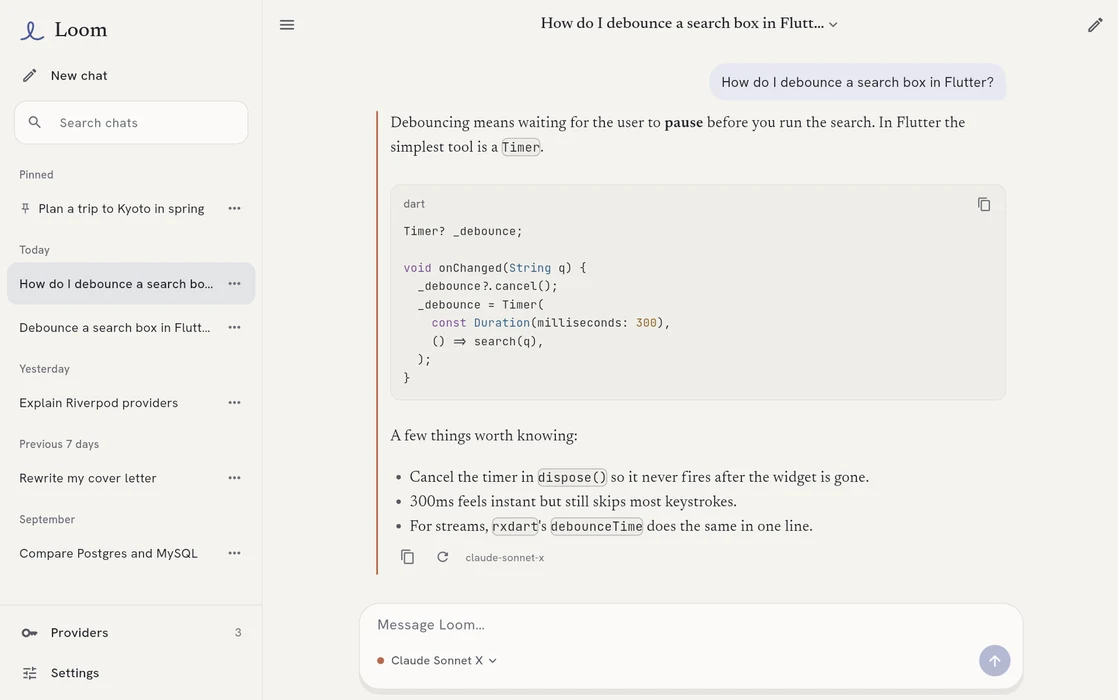
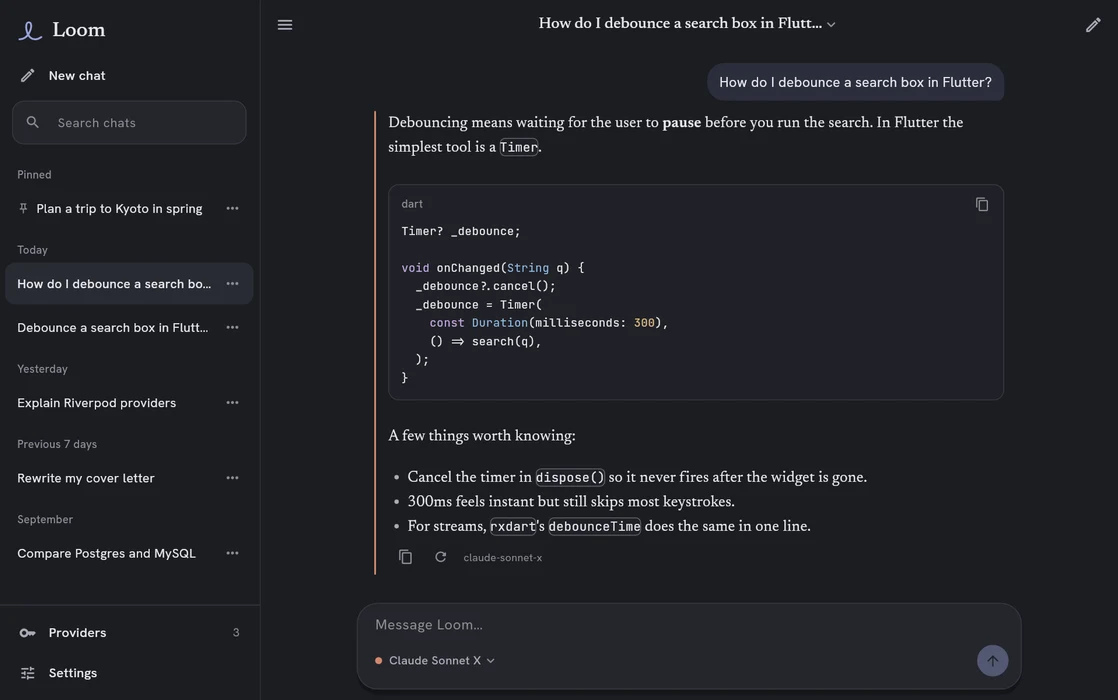
On a phone, chats slide in from a drawer. On a tablet, the conversation sits in a centred column. On a desktop, the sidebar stays put and the keyboard does the work: Enter to send, Cmd or Ctrl N for a new chat, K to search.
Yes. Loom works with API keys from Anthropic, OpenAI, Google AI Studio, OpenRouter and about thirty other services, or with a model you run yourself, for example with Ollama. It can’t sign in with a claude.ai, ChatGPT or Gemini app subscription, because those products don’t offer that to other apps. The guides show where to get a key for each one, step by step.
In files on your own device. You can search, rename, pin and delete them, and export any chat as Markdown.
No. There is no Loom server for messages to pass through. They go from your device to the provider you picked, under that provider’s own terms.
Soon. Android, iPhone and Mac come first. This page will change when there is something to download.
It sets no cookies and runs no analytics or ad scripts. The only thing it remembers is your light or dark choice, on your own device.
One quiet place for every model you use.